Showing posts with label compressor station. Show all posts

Tuesday, June 6, 2017

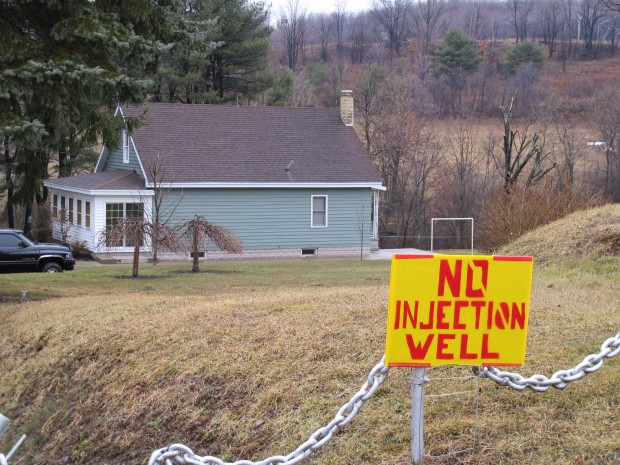
The 11th Injection Well Approved in Pennsylvania


A sign protesting a proposed deep injection well sits on the lawn of a home in Brady Township, Clearfield County.
A sign protesting a proposed deep injection well sits on the lawn of a home in Brady Township, Clearfield County. Community opposition to deep injection wells is strong because of links with earthquakes and fears of drinking water contamination.


Injection wells are now being permitted in Pennsylvania.  Injection wells are installed to store fracking fluids from gas well drilling.  In other areas of the country, for example, Oklahoma, injection wells have been linked to earthquakes, seismic activity, and underground pollution of water.  I guess injection wells are going to be increasing in number.  It is truly troubling that, added to more and more pipelines and compressor stations, we must face the consequences of all these threats to our environment and our health.

https://stateimpact.npr.org/pennsylvania/2017/06/05/pa-dep-approved-11th-underground-injection-well-for-oil-and-gas-waste/

Sunday, August 31, 2014

Shalefield Stories: "I will not be quiet anymore."

Michelle Beegle: PA farmer, nurse, grandmother
Clearville, Bedford County, PA
We’ve lived on our land since 1983. It was given to our generation by my father-in-law. I loved it here. It was quiet. If you saw more than one car all day something was going on. We could sit on
our porch and be out in the yard, and only hear birds singing all the time. We never worried about what we were drinking or breathing. Our three children were born and raised here. Back then everyone got along with their neighbors. Everyone is family. We keep an eye out for everyone. You could count on people. Now there’s a division between people.

In 2014 we applied for a second mortgage. We wanted to update the furnace, the bathroom, and put in a pool for the grandchildren and my husband, Robert. The water therapy is good for him. He suffers from severe back pain and neuropathy that was caused when a tree fell on him in January of 1988. We applied for a $15,000 loan. Our credit was excellent and our home had recently been appraised at $125,000. We didn’t expect a problem. Our home and our credit is all we have.
Robert doesn’t believe in credit cards. “If you can’t afford it, you don’t need it,” he always says. We had previously taken out a loan on the house to help pay for our youngest daughter to go to nursing
school. We’ve never missed a payment on the house and we paid off our last car loan early. We went straight to Hometown Bank of Pennsylvania. We have banked with them for the last 10 years. We filled out the paperwork and were initially approved. A few days later, Carol at the bank called us. She explained that the attorney had looked at the loan and it was too big of a risk for them. She said that since the water well was contaminated, the property wasn’t even worth the $33,000 we
still owed on it. They said it was worth nothing. We tried three other banks, but the result was the same. At first they would approve us but as soon as they saw the tax assessment said “contaminated well” they turned us down.


Read the full article here.

Wednesday, October 2, 2013

Ginormous Compressor Station: Wyalusing, PA

A massive site, still under construction. The Compressor on the left (west) is the CNYOG.
The smaller compressor nearest the road (to the south, or bottom of the photo) seems to be an existing compressor for the TGP300 line. The rest of the complex, with several additional large compressors is apparently in support of the TGP300 Northeast Upgrade Project.

 Check out Bill Huston's blog report here. You will find many maps and pictures (which I can't put up here easily!).  Well worth checking out for yourself. 
 
If you are a member of the Hutchinson family, as I am, this compressor station is across the river from Frenchtown, not very far as the crow flies.  The air pollution from compressor stations is very significant. Also light and noise pollution.  But I am mainly concerned about the air quality.  Our property is not safe with a compressor station like this nearby.  But we may not smell or see anything.  It is there nonetheless.  Yes, we have been fracked on our property.  No, we don't have wells, but we have been fracked, if you get my drift.  Drilling is so much more than just fracking.  The industry would have us focus on fracking only, while it goes about its business of ruining the environment and our property forever.  No going back.
 
Links to more information:
 
 
And you can search this blog for many more posts from the last few years. Use the "Search this blog" feature.


Saturday, March 30, 2013

Gas Rush Stories: Part Five (Pennsylvania)


Gas Rush Stories, part 5: A Neighbor from Kirsi Jansa Plus     1 year ago

Gas Rush Stories is a series of short documentaries about natural gas drilling in Pennsylvania. In the 5th chapter of Gas Rush Stories Pam Judy from Carmichaels, Greene County, tells about her family's experiences living close to a compressor station. Legal Director Joe Osborne from GASP, Group Against Smog and Pollution, explains about the air emissions coming from the shale gas industry.

Watch also: Gas Rush Stories Extra: Joe Osborne, GASP, vimeo.com/38794879

MORE INFO ON GAS RUSH STORIES: gasrushstories.com

Monday, February 11, 2013

Marcellus Gas Drilling: The Mannings Tell Their Story

In less than 10 minutes, this video shines a light on the Mannings in Pennsylvania whose water is ruined. Listen to how their life has changed since hydrofracking began near their home. How much help have they gotten from the DEP or the gas company?

Saturday, January 12, 2013

Marcellus Shale: Citizen Craig Stevens Speaks To Local Government Officials

Listen to Craig Stevens of Susquehanna County, PA, as he speaks truth to power at a Planning Commissioner's meeting January 9th. He cites possible illegal votes in connection with a compressor station. Look at the officials as they "listen." They show no emotion except boredom and concern for time. It is as if Mr. Stevens is hardly there or as if they cannot hear what he is saying. Very infuriating in my opinion. This is what is happening all over the country it seems. Local people, who stand to lose everything that makes their life liveable, are treated as if they don't matter. This was a civil encounter, that is, no fur flying, no disrespectful or insulting exchanges, but the lack of concern and the disinterest which these officials display here is really unacceptable.

The videographer Vera Scroggins explains what is happening in the video:

"Craig Stevens speaks powerfully about what happened at the previous night's Planning Commission Special Meeting in Montrose, Pa.. See how our Commissioners act and listen and are not protecting us. Who are they representing?"

Craig Stevens came to Albany January 9th and spoke to the anti-fracking crowd who were there for an action in connection with Governor Cuomo's State of the State address in which he did not even mention gas drilling.  Thank you, Craig Stevens, for taking the time to come to New York to try to let people know what we have in store if the Governor gives the go-ahead on gas drilling permits next month.  Please let us listen to Craig and ban fracking in New York state at least until the reports are completed on health impacts.

Monday, June 25, 2012

Compressor Station Explosion Kills One

http://www.durangoherald.com/article/20120625/NEWS01/706259928/One-dead-in-explosion-at-BP-compression-station


Article published Jun 25, 2012

One dead in explosion at BP compression station


By Shane Benjamin
An explosion at a large gas compression station owned by BP killed one worker and seriously injured two others.
The explosion, which occurred at about 8:15 a.m. today at BP’s Piñon Compression Station, temporarily closed U.S. Highway 160 five miles east of Elmore’s Corner.
“At this time the immediate concern is for the people involved,” Julie Levy, a spokeswoman for BP.
Dan Bender, spokesman for the La Plata County Sheriff’s Office, said one was confirmed dead and two seriously injured. There were several other workers on site at the time.
Residents in the area reported hearing the explosion. Bender said there was an explosion but no fire followed. There is no ongoing risk at the facility in conjunction with the explosion, he said.
The highway was reopened after about a half an hour.
The compression station is BP’s largest in La Plata County. The company routinely works with local emergency workers on disaster plans in the event of an explosion.
The compression station is one of two major facilities owned by BP where natural gas is gathered to be put in a pipeline.
It is located in the 35000 block north of Highway 160 near a fire station owned by the Upper Pine Fire Protection District.
Further details were not immediately available.
shane@durangoherald.com
Message from:
Gwen Lachelt, Founder & Director
Earthworks' Oil & Gas Accountability Project
970-259-3353 x 1
505-469-0380

NATIONAL DAY OF ACTION ON FRACKING • JULY 28 • THE US CAPITOL • WASHINGTON, DC • SIGN UP HERE: http://www.stopthefrackattack.org/

Tuesday, June 12, 2012

Hancock, NY, Compressor Station: How Loud Would It Be?

A creative edit of Steve Sullivan, spokesmen for Millennium Pipeline Company, with Anthony DePalma (Delaware Lake Assocation) and graphics illustrating what 15,000 horsepower is like... Will it sound like a refrigerator?

Sunday, April 29, 2012

Compressor Stations In Our Backyards?

A leader in the fight against the anti-health, anti-environment, anti-people, greed-filled gas industry speaks at a DEP Public Meeting at Elk Lake School in Susquehanna County.  She and others testified about our concerns. Four more Gas Compressors are coming to Susquehanna County in the north along the Laser Gathering Line. Tons of emissions are allowed for each and constant noise emissions. Taped 4-26-12.

We cannot allow Big Gas to pollute our residential areas.  Gas drilling is unhealthy for children and other living things.
Thank you, Vera, for your work to save Pennsylvania and all areas being destroyed by Big Gas.

Sunday, April 22, 2012

Thursday, April 5, 2012

Williams Partners Disregard PA DEP Request At Compressor Station

A compressor station in Susquehanna County, PA, was the site of a huge explosion March 29. Gas seeped into the building and ignited, blowing off part of the roof and damaging two of its seven compressor engines. Despite the DEP's advice NOT to run the station, Williams restarted operations the next day, March 30. It was a "procedural misunderstanding," according to a company spokesperson said. However, a DEP representative said there was no lack of clarity and the DEP is disappointed that its advice was not followed. No enforcement order is being considered, and there may or may not be a fine for either the explosion or the disregarding the DEP shutdown request.

This is totally unacceptable. Is there no way to enforce safe procedures? Gas companies are not scared of regulations or fines. The fines are puny and ineffective. And PA does not have enough inspectors to do the job they need to do to protect people and the environment. Compliance is optional. A company can always argue some fine point of any agreement and get off the hot seat. Even the state Public Utility Commission, which has inspectors on site, is apparently not sure it has jurisdiction over the Lathrop station. In most rural areas (places with 10 or fewer homes within a 220-yard radius of a facility), it does not have jurisdiction. The PUC is still trying to determine if it has oversight authority for the Lathrop station.

So while the gas company Williams, the PA DEP, and the PA DUC all weigh in on this situation, the public remains in possible danger.

Thursday, March 22, 2012

Wyoming Compressor Station Explodes


The Falcon natural gas compressor station south of Pinedale burns and then explodes into a column of flame midday Dec. 6. Nobody was directly injured in the fire and explosion, which was triggered by venting natural gas at the station, which is part of a system to collect natural gas from the Jonah and Pinedale Anticline fields. The fire was allowed to burn out, under the watchful eyes of area firefighters.

Saturday, January 14, 2012

Wyoming Natural Gas Compressor Station Explodes


The Falcon natural gas compressor station south of Pinedale (Wyoming) burns and then explodes into a column of flame midday Dec. 6, 2012, in this submitted video. Nobody was directly injured in the fire and explosion, which was triggered by venting natural gas at the station, which is part of a system to collect natural gas from the Jonah and Pinedale Anticline fields. The fire was allowed to burn out, under the watchful eyes of area firefighters.

Read more.

Saturday, September 24, 2011

The Real Cost of Fracking: Angela and Wayne


Angela and Wayne Smith live in Clearville, PA. They have beef cattle and grow bluberries. In 2007 gas companies put in storage wells near the Smiths. Water pollution ensued. A horse died an agonizing death (*footage disturbing), followed by the deaths of a cow, a dog, and a chicken. The Smiths suffered headaches. They had to install and pay for an $11,000 water treatment system. A compressor station was built near them which blew up, spraying everything with oil. Their blueberry sales went down. They had wanted to give the farm to their grandchildren eventually. Angela says, "Why give death to our grandchildren, because that's what this is. Who would want to live here?"

Video filmed and edited by Kellan Davidson. For more information, go to Coalition To Protect New York.

Friday, August 26, 2011

A Compressor Station Comes to Your Neighborhood

Compressor Station in Hickory, PA
  According to the next door neighbor, "It is lit up like a Walmart parking lot at night." A recent visitor to the house next door reported bad odors and loud noise from this compressor station and wondered aloud, "How can people live next to this? What are they breathing?"

This compressor station near Hickory has plans to go from housing two to four Cat 1340 HP compressors.

Fulton Compressor Station Washington Avenue, Hickory, PA
Permitted total facility allowed emissions are:NOx - 38.94 TONS per year
VOC - 12.40 TONS per year
CO - 49.02 TONS per year
 
The emission figures above are for the original two compressors,
with four compressors these amounts would double to:
NOx - 77.88 TONS per year
VOC - 24.80 TONS per year
CO - 98.04 TONS per year


A personal story:
July 20, 2011

Dear Council:

Thank you for the opportunity to share with you my family’s personal story as it relates to various health issues we have been experiencing after a Marcellus Shale compressor station was built near our home.

My name is Pam Judy. I am a resident of Carmichaels in Greene County.

In April 2006 we built a new home on property originally belonging to great grandparents and a part of the family farm. For three years my family enjoyed the peace and quiet of living in the country. However, in the spring of 2009, that quiet way of life abruptly came to an end when a compressor station was built 780 feet from our home on an adjoining landowner’s property.

Due to the noise and the fumes from the engines and dehydration unit that settle in our yard we can no longer spend time outdoors. Shortly after operations began, we started to experience extreme headaches, runny noses, sore/scratchy throats, muscle aches and a constant feeling of fatigue. Both of our children are experiencing nose bleeds and I’ve had dizziness, vomiting and vertigo to the point that I couldn’t stand and was taken to an emergency room. Our daughter has commented that she feels as though she has cement in her bones.

In November of last year our son was out on our property scouting for deer in preparation for the opening day of the season. Some of these areas were in close proximity to the compressor site. Within one day of being out, he developed blisters in his mouth and throat, had extreme difficulty swallowing, and on Thanksgiving morning he went to the emergency room of a nearby hospital.

After conducting research regarding possible emissions from facilities such as this, and the associated illnesses, I contacted Calvin Tillman, Mayor of Dish Texas. Dish residents had experienced a similar problem a few years ago when drilling was done into the Barnett Shale. Mayor Tillman provided me with a list of blood and urine tests which could be done to determine exposure. In May 2010 I had those tests performed and the results revealed my body contained measurable levels of benzene and phenol.

This prompted me to become even more vigilant in determining what we were being exposed to. In June 2010, I was able to convince the PA DEP to conduct an air quality study which focused on concentrations of volatile organic compounds typically found in petroleum products. The study consisted of a 24 hour canister air sampling in my yard and 4 days of monitoring at the site where an infrared camera was used.

The results of the 24 hour canister sampling revealed 16 chemicals including benzene, styrene, toluene, xylene, hexane, heptane, acetone, acrolein, propene, carbon tetrachloride and chloromethane to name a few.

Most, if not all, of the aforementioned compounds are known carcinogens and, if exposed, carry with them the very symptoms my family and I have been experiencing. Benzene has been directly linked to various blood cancers including leukemia and Non-Hodgkin’s Lymphoma.

In November 2010 the DEP released their final report regarding findings at this site as well as four additional locations. That report states the department could find no emission levels that would constitute a concern to the health of residents living near Marcellus operations and that the sampling results were used to characterize the acute non-cancer health risks associated with industry emissions. The report further states that they did not address the cumulative or long-term impact of air emissions or the lifetime cancer risks because this was a short-term study.

Given the health issues we have been experiencing since this facility began operations, I am extremely concerned that as a result of prolonged exposure to the previously mentioned chemicals, we will develop even more serious health issues including cancer. Yet this report focused on the non-cancerous health risks.

As the Marcellus industry continues to grow so does the number of compressor sites required. With every compressor site comes increased atmospheric hydrocarbon emissions that will, in my opinion, and in the opinion of former DEP Secretary John Hanger, have a huge cumulative impact on air quality in PA.

As a local governing body you have the authority to impose restrictions on companies wanting to do business in your community. I would implore you to exercise that authority and establish set-backs so that compressor sites cannot be built 780 feet from a residence. I realize that such facilities are a necessary evil of this industry. However, they should be built in more desolate areas with the least amount of impact.

I have likened the Marcellus industry to that of the asbestos industry years ago. Both our government, and the asbestos industry, through very elaborate public relations schemes led us to believe there was no harm in being exposed to asbestos. Only to find out years later the true cancer risks. I truly believe we could be facing a similar situation as a result of the Marcellus industry. And for those of who have been exposed it could be too late.

For this reason, I would ask that you take every precaution to protect the residents of your community. It is your duty as elected officials to insure their welfare and safety. A charge you should not take lightly.

Should any members of council wish to speak with me in person, I would be more than happy to do so. And if I can be of any assistance, please do not hesitate to contact me.

Respectfully,
Pam Judy

Check out this excellent web site:  http://www.marcellus-shale.us/
The information and photos in this post are all from this great site.  Take a look.  There are many pictures which, of course, are worth a thousand words.  Thank you, Stephanie Hallowich!

Compressor Station, Washington County, PA
More than just a colossal eyesore!


Monday, August 8, 2011

Marcellus Shale Reality Tour: Bradford County, PA


This 40-minute film shows a group of 15 citizens from Luzerne County, PA, including some public office holders, as they traveled by bus to Bradford County, PA, to see firsthand the drilling operations in all its stages, including compressor stations and pipelines. Compelling testimony from land owners who have been severely impacted by the gas drilling industry.

The film project was done by GDAC. (Gas Drilling Awareness Coalition)  Check out their website.

Tuesday, May 10, 2011

The Sights and Sounds of Natrual Gas Drilling: Susquehanna County, PA


Gas Drilling in Beautiful Susquehanna County, PA from VeccVideography on Vimeo.

Air pollution, noise pollution, water pollution, they all come with the territory.  Welcome to an industrial zone, aka a sacrifice zone, because every single gas well site has the potential to becomes superfund site after all is said and done. Remember Love Canal?

http://gasmain.org/
http://un-naturalgas.org/
http://www.endocrinedisruption.com/chemicals.introduction.php

Sign at Love Canal Protest:  We have better things to do than sit around being contaminated.

Saturday, February 19, 2011

Compressor Stations Emit Toxic Gas Into the Air


My name is Scott Cannon. I shot this video. I am a professional videographer and have been employed by PBS and NBC. I mention in the video that the second site is owned by Cabot. It is a compressor station, and a compressor station being built by a school is what were are questioning. I will protect the name of my source who lives in that area and has been studying the drilling operations for some time..

Peacegirl writes: Listen to the sound of the working compressor station in Dimock.  Look at the methane being emitted into the air.  It can't be seen by the naked eye.