Showing posts with label injection wells. Show all posts

Tuesday, June 6, 2017

The 11th Injection Well Approved in Pennsylvania


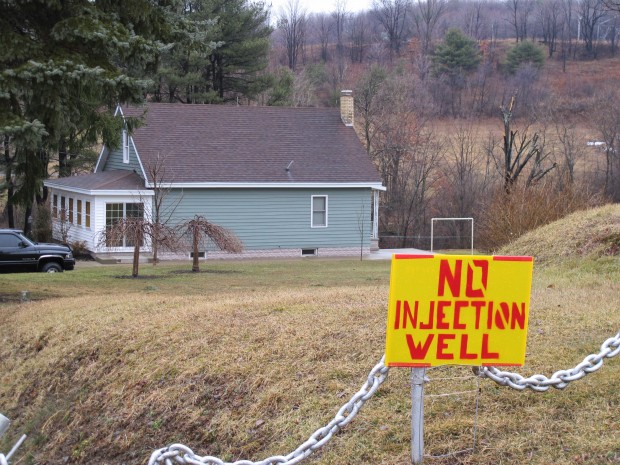
A sign protesting a proposed deep injection well sits on the lawn of a home in Brady Township, Clearfield County.
A sign protesting a proposed deep injection well sits on the lawn of a home in Brady Township, Clearfield County. Community opposition to deep injection wells is strong because of links with earthquakes and fears of drinking water contamination.


Injection wells are now being permitted in Pennsylvania.  Injection wells are installed to store fracking fluids from gas well drilling.  In other areas of the country, for example, Oklahoma, injection wells have been linked to earthquakes, seismic activity, and underground pollution of water.  I guess injection wells are going to be increasing in number.  It is truly troubling that, added to more and more pipelines and compressor stations, we must face the consequences of all these threats to our environment and our health.

https://stateimpact.npr.org/pennsylvania/2017/06/05/pa-dep-approved-11th-underground-injection-well-for-oil-and-gas-waste/

Saturday, July 19, 2014

California Halts Injection of Fracking Waste, Warning it May Be Contaminating Aquifers

"California officials have ordered an emergency shut-down of 11 oil and gas waste injection sites and a review more than 100 others in the state's drought-wracked Central Valley out of fear that companies may have been pumping fracking fluids and other toxic waste into drinking water aquifers there.

The state's Division of Oil and Gas and Geothermal Resources on July 7 issued cease and desist orders to seven energy companies warning that they may be injecting their waste into aquifers that could be a source of drinking water, and stating that their waste disposal "poses danger to life, health, property, and natural resources." The orders were first reported by the Bakersfield Californian, and the state has confirmed with ProPublica that its investigation is expanding to look at additional wells."


Read the article by Abrahm Lustgarten (ProPublica) here.

My comment (Peacegirl):  First gas wells were being drilled (still are), and we didn't know for sure what harm would done to humans, animals, soil, air, and water (still don't know everything).  Next there were the pipelines and compressor stations, and we didn't know (still don't) what the negative effects would be on our daily lives.  Now we have earthquakes and injection wells, and we really have absolutely no clue about what is (or can) really happen as a result of these practices.  But we have all this frack waste.  We have to put it somewhere.  So I think we are really in a terrible bind.  One thing leads to another, and now we are in over our brilliant little heads.  Some people are getting filthy rich, and the rest of us are wondering what kind of world we will leave to our children and grandchildren, if indeed there will be a liveable planet for them.

Thursday, July 17, 2014

Seismic Study To Be Done In Oklahoma: 4500 Disposal Wells and Earthquakes Linked

An E&E Publishing Service

EARTHQUAKES: Okla. agency gets $1.8M to study seismic links to drilling (Wednesday, July 16, 2014)

Mike Soraghan, E&E reporter
Earthquake researchers in Oklahoma have received nearly $2 million from the federal government to study connections between the state's surge in quakes and oil and gas drilling activities.
The Oklahoma Geological Survey will use the money to buy new equipment and hire researchers to analyze piles of research about the drilling wastewater injected into the state's 4,500 disposal wells, said Director G. Randy Keller.
The two-year, $1.8 million grant is from the Department of Energy's Research Partnership to Secure Energy for America (RPSEA). The state, the University of Oklahoma, and the oil and gas industry provided a 20 percent match.
"The whole scheme of things is to produce a really detailed 3-D model of the earth down 10 miles or more," Keller said.
Oklahoma has become the most seismically active state in the lower 48 in the last few months, and many have pointed the blame at disposal wells used to inject wastewater from oil and gas drilling.
The state has had more earthquakes magnitude 3 or higher than California in the last nine months (EnergyWire, May 7). There's been a fortyfold increase during the period of 2008 to 2013 compared with 1976 to 2007.
In 2014, Oklahoma has had twice as many quakes as California, though it's only half the size.
There also have been earthquakes linked to injection in Arkansas, Colorado, Kansas, Ohio and Texas.
The U.S. Geological Survey and academic researchers have linked much of the increase in Oklahoma to deep injection of waste fluid from oil and gas production in the drilling-heavy state.
OGS has been the voice of skepticism in the seismology community on links between drilling activities and earthquakes. The agency has said it is premature to link the earthquakes to wastewater disposal and rebutted the findings of other researchers.
In anticipation of a March 2013 study finding that the state's largest earthquake was induced by disposal, OGS released its own conclusions that it was the result of natural causes (EnergyWire, March 27, 2013).
When areas north of Oklahoma City were rattled by a swarm of smaller earthquakes in November, OGS posted a report pointing away from oil and gas activities and toward changing water levels in nearby Arcadia Lake. Other researchers have linked the swarm to oil production in the area that produces huge volumes of water.
But OGS seismologist Austin Holland has linked very small earthquakes and the hydraulic fracturing of an oil well. And his research contributed to state officials' decision last year to sharply restrict injection at a well site near Marietta, Okla., after a nearby earthquake.
OGS applied for the grant in December and got official word that it had been approved for the grant last month.

Want to read more stories like this?

Click here to start a free trial to E&E -- the best way to track policy and markets.

About EnergyWire

EnergyWire is written and produced by the staff of E&E Publishing, LLC. EnergyWire is designed to bring readers deep, broad and insightful coverage of the transformation of the energy sector. EnergyWire focuses on the business, environmental and political issues surrounding the rapidly expanding unconventional energy industry and the numerous factors -- from expanding natural gas use to renewables and more -- that are altering the traditional electric utility industry. EnergyWire publishes daily at 9:00 a.m.
Image removed by sender.
E&E Publishing, LLC
122 C St., Ste. 722, NW, Wash., D.C. 20001.
Phone: 202-628-6500. Fax: 202-737-5299.
www.eenews.net

Saturday, July 12, 2014

Earthquakes in Oklahoma Tied To Fracking and Injection Wells

Protecting Our Waters Blog has posted this compelling article about 2500 earthquakes in Oklahoma.  Are we pouring poison into the Earth without appreciating the dire consequences?

Read the article here.

We must use our brains a lot more than we are doing now.  Mother Earth will have the last word.  She will.  How much more destruction do we think she can endure?

Tuesday, July 9, 2013

Gas Bridge To a Cooked Planet: Chip Northrup


Watch the trailer of Josh Fox's brilliant new documentary Gasland Part 2.

Below is Chip Northrup's commentary on the new documentary Gasland Part 2 by Josh Fox.

http://blog.shaleshockmedia.org/2013/07/09/gas-bridge-to-a-cooked-planet/

Northrup provides a lot of great information, including graphs showing what will happen in the near future if we continue to use fossil fuels or if we go to sustainables.

 
Where are we going when there is no more water to drink here on Planet Earth?

Tuesday, October 2, 2012

Louis W. Allstadt On Gas Drilling In New York State and the SGEIS

Lou Allstadt discusses the enormous inadequacies of the New York State SGEIS. His talk can also be viewed here: www.otsego2000.org. For an excellent article on this topic, click HERE. Lou Allstadt is a former Mobil Oil Corp. executive. Initially a proponent of gas drilling, he now is "convinced the economic prospects are largely hype and that the state's environmental regulators are disturbingly unprepared to deal with the side effects of such an invasive industrial activity."